Struggling with your essay introduction? You’re not alone. The first paragraph of your essay can make or break your reader’s interest. In this guide, I’ll show you exactly how to craft an introduction that grabs attention, provides context, and sets up your entire essay for success.
What is an Essay Introduction?
Your essay introduction is like a first impression. It’s the opening paragraph that invites readers into your paper and gives them a roadmap of what’s to come.
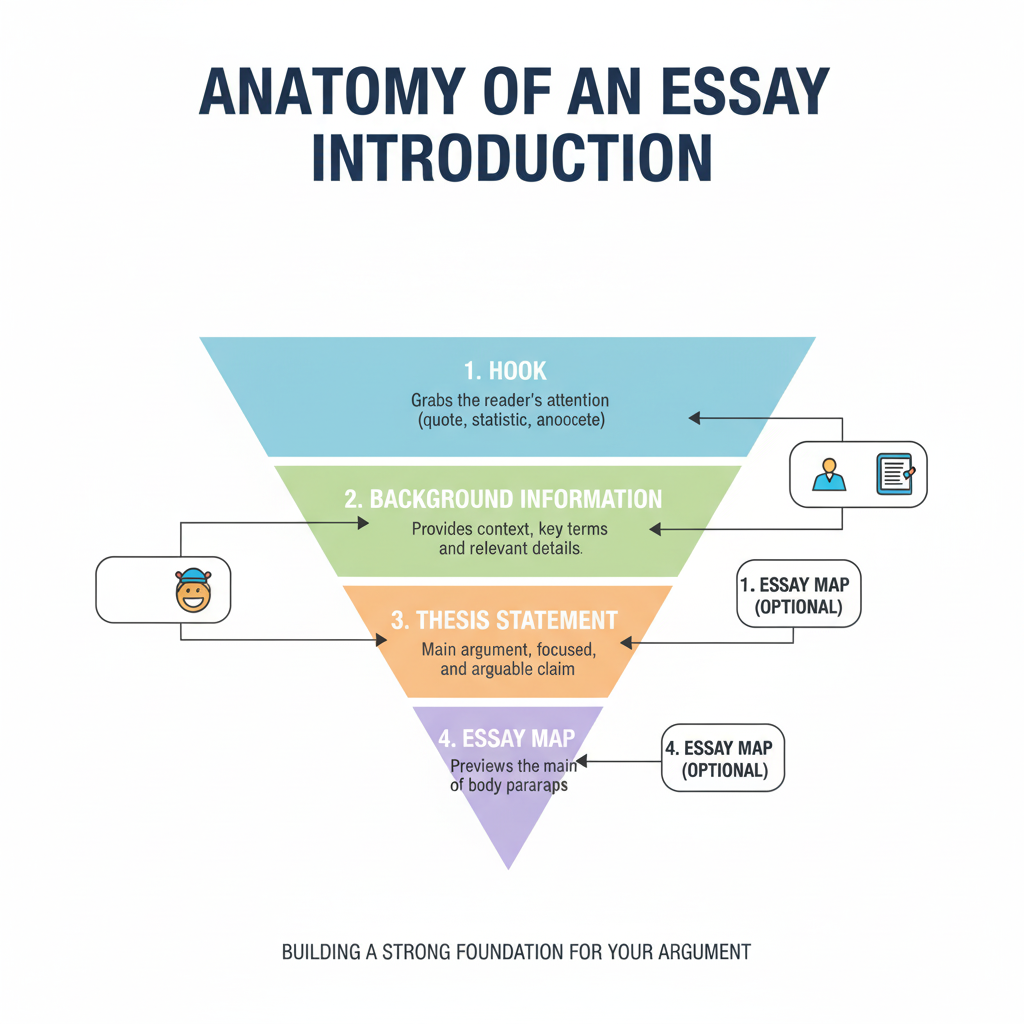
An effective introduction accomplishes three key things: it hooks your reader’s attention, provides necessary background information, and presents your thesis statement clearly.
Think of it as the front door to your essay—it needs to be welcoming and give a clear idea of what’s inside.
What to Include in an Essay Introduction?
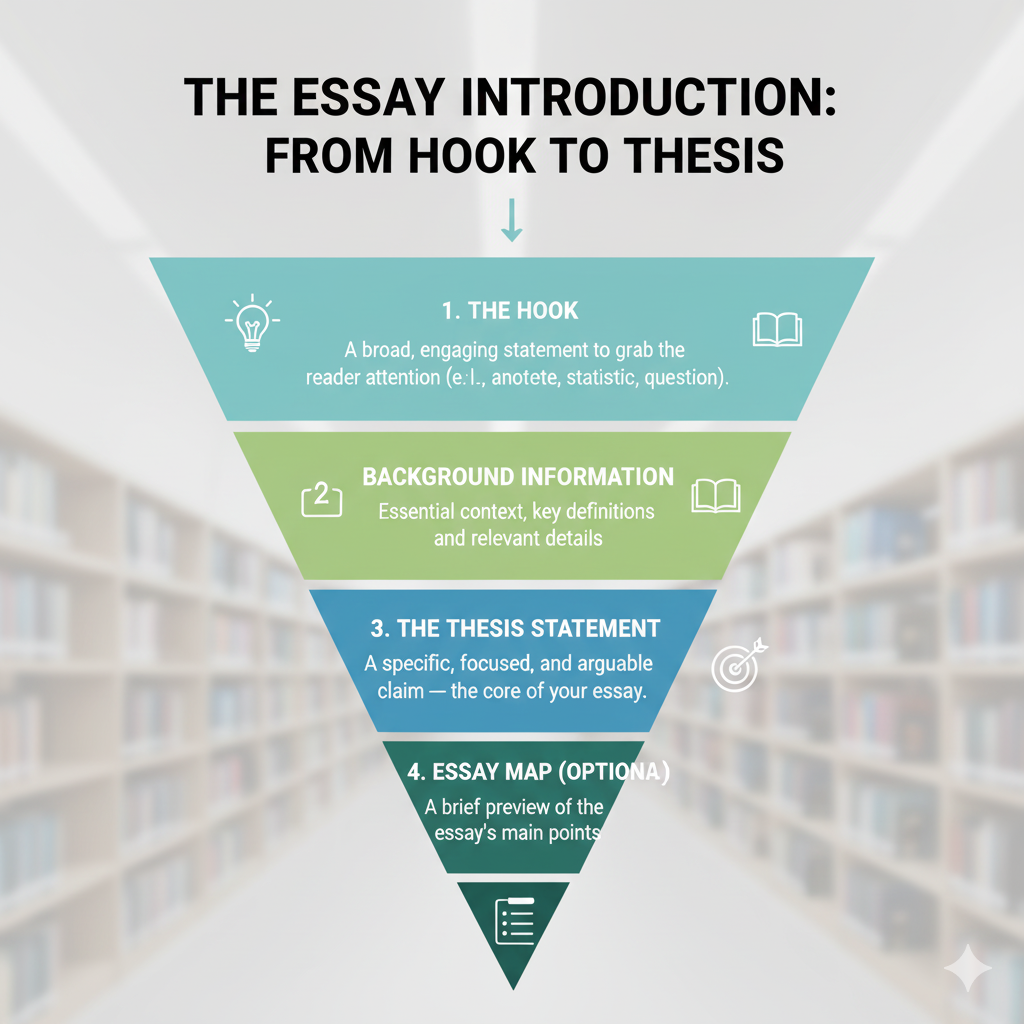
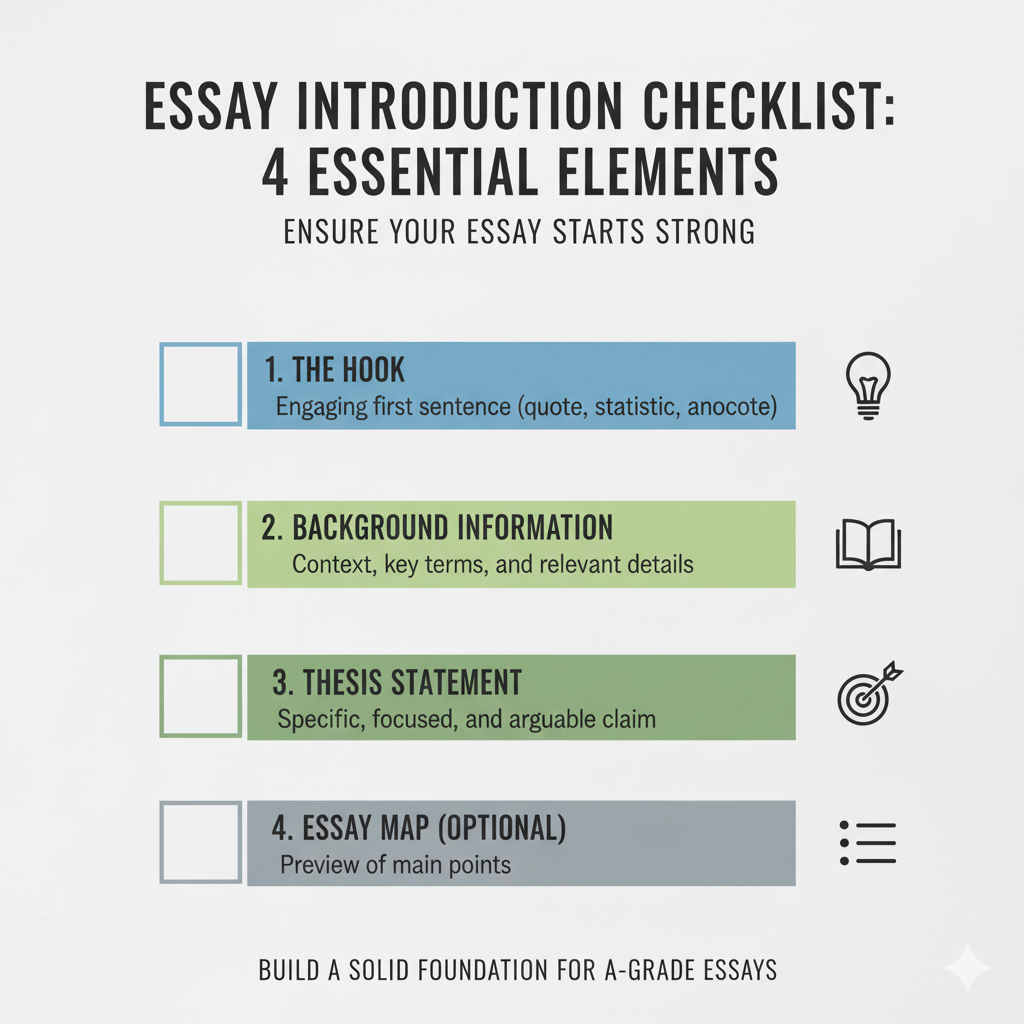
Every strong essay introduction contains four essential elements that work together to set up your paper perfectly.
1. A compelling hook that grabs attention immediately.
2. Relevant background information that contextualizes your topic.
3. A clear thesis statement that presents your main argument or position.
4. A brief outline of how your essay will develop (for longer papers).
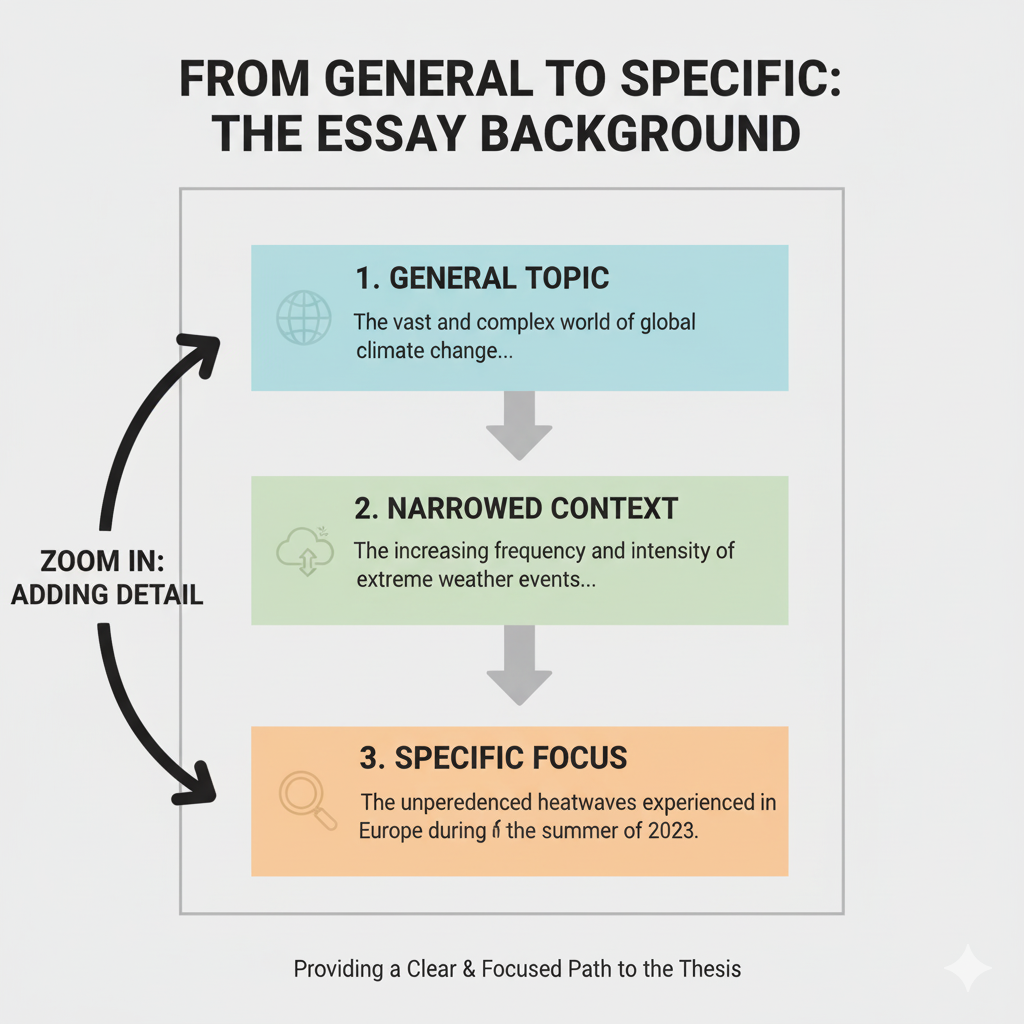
These elements flow from broad to specific, gradually narrowing your focus toward your precise argument.
How to Write a Hook for Your Essay
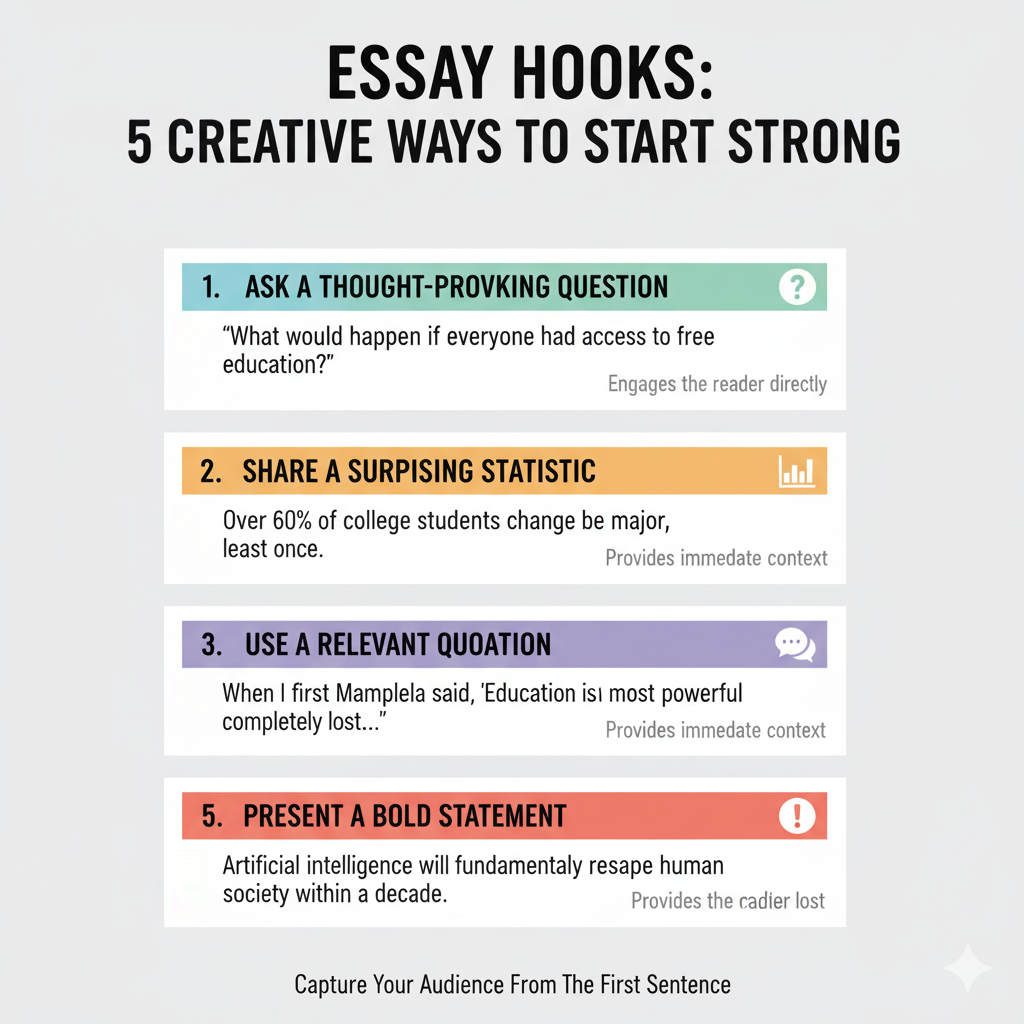
Your hook is your opening line—the first chance to capture your reader’s interest. A great hook makes readers think, “I need to know more about this.”
Try these proven hook strategies:
- Ask a thought-provoking question: “What would happen if everyone had access to free education?”
- Share a surprising statistic: “Over 60% of college students change their major at least once.”
- Use a relevant quotation: “As Nelson Mandela said, ‘Education is the most powerful weapon…'”
- Tell a brief anecdote: “When I first attempted calculus, I was completely lost.”
- Present a bold statement: “Artificial intelligence will fundamentally reshape human society within a decade.”
The best hook relates directly to your topic while sparking curiosity.
How to Include Background Information
After hooking your reader, provide context that helps them understand why your topic matters. This bridges the gap between your attention-grabbing opening and your specific thesis.
Keep background information:
- Relevant to your specific topic
- Brief and focused (2-3 sentences is often enough)
- Gradually narrowing toward your thesis
- Free of unnecessary details or history
For example, in an essay about social media’s effects on teenagers, your background might briefly mention the rise of platforms like Instagram and TikTok, their popularity among teens, and growing concerns about their impact.
How to Write a Thesis Statement
Your thesis statement is the heart of your introduction—the main point your entire essay will support. It should appear near the end of your introduction and clearly state your position or argument.
A strong thesis statement:
- Makes a specific claim or observation
- Takes a clear position (if argumentative)
- Is concise (usually one sentence)
- Provides direction for your entire essay
- Can be supported with evidence
For example: “While social media platforms offer teenagers valuable social connections, their design features deliberately maximize screen time, contributing to increased anxiety, disrupted sleep patterns, and decreased face-to-face interactions.”
Step-by-Step Guide to Writing an Essay Introduction
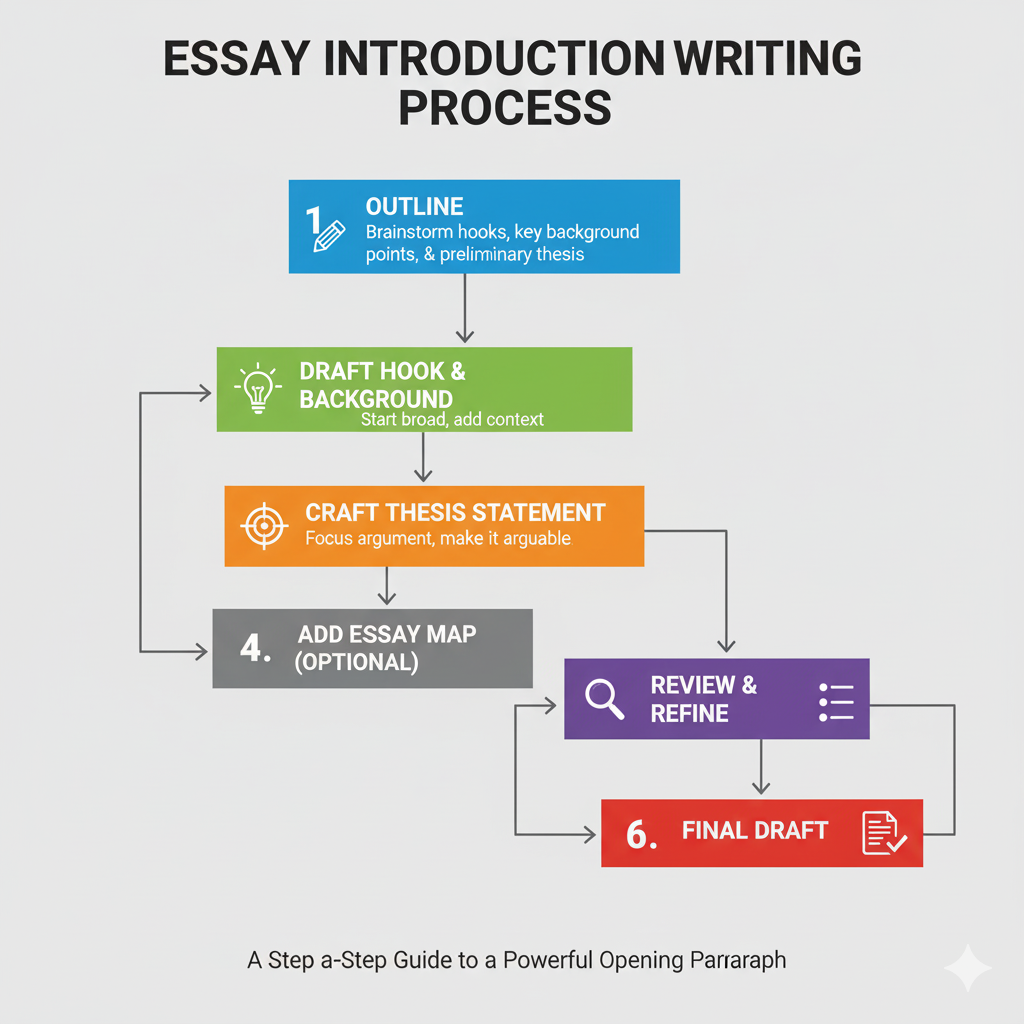
Step 1: Build an Outline
Before writing your introduction, outline your entire essay. Knowing your main points helps you craft an introduction that properly sets up what follows.
Jot down your thesis and the key supporting points you’ll make in each paragraph. This roadmap makes writing your introduction much easier.
Step 2: Start with a Hook
Begin with something attention-grabbing that relates to your topic. Remember, you want readers to think, “This is interesting—I want to keep reading.”
Choose the hook type that best fits your essay style and topic.
Step 3: Provide Background Information
After your hook, add 2-3 sentences that give context about your topic. This helps readers understand why your subject matters and prepares them for your thesis.
Keep this section concise—just enough information to set the stage.
Step 4: State Your Thesis Statement
End your introduction with your thesis statement—the central argument or point of your essay. Make it clear, specific, and debatable (if appropriate for your essay type).
For longer essays, you might also briefly outline how your paper will develop.
Examples of Essay Introductions
Argumentative Essay Introduction Example:
“In 2023, American students spent an average of 7 hours daily on digital devices—more time than they spent sleeping. While technology has revolutionized education, the unchecked proliferation of screens in classrooms has created a generation of distracted learners with diminishing attention spans. Despite claims about digital literacy benefits, schools must implement strict limits on screen time to protect students’ cognitive development, social skills, and mental health.”
Expository Essay Introduction Example:
“The human brain processes images 60,000 times faster than text, making visual communication one of our most powerful tools. From ancient cave paintings to modern infographics, visual elements have shaped how we share and understand information. By examining three key principles of visual communication—contrast, hierarchy, and simplicity—we can better understand how to create images that effectively convey complex messages.”
Literary Analysis Essay Introduction Example:
“‘All happy families are alike; each unhappy family is unhappy in its own way.’ With this famous opening line, Leo Tolstoy introduces the complex family dynamics that drive his masterpiece, Anna Karenina. Throughout the novel, Tolstoy uses parallel family structures—the Karenins, Oblonskys, and Levins—to explore different manifestations of love, betrayal, and forgiveness. By contrasting these family units, Tolstoy ultimately suggests that authentic relationships require both personal honesty and moral compromise.”
Check and Revise – Checklist for Essay Introduction
Before submitting your essay, use this checklist to evaluate your introduction:
- Does your hook effectively grab attention?
- Have you provided relevant background information?
- Is your thesis statement clear and specific?
- Does the introduction flow logically from broad to specific?
- Is the length appropriate (typically 10-15% of your total essay)?
- Have you avoided clichés and overly general statements?
- Does the introduction match the tone and style of the rest of your essay?
- Have you eliminated unnecessary information?
Take time to revise your introduction after finishing your essay—sometimes your conclusion can help you strengthen your opening.
Tips for Different Essay Types
Different essay types require slightly different approaches to introductions:
Narrative essays: Open with a moment of action or dialogue that pulls readers into your story.
Descriptive essays: Begin with vivid sensory details that immerse readers in the scene you’re describing.
Compare/contrast essays: Start by identifying the two subjects and hint at the comparison basis.
Cause/effect essays: Open with the significance of the relationship you’re analyzing.
Research papers: Begin with the broader research context before narrowing to your specific contribution.
Adapt these guidelines to fit your specific assignment requirements.
Common Introduction Mistakes to Avoid
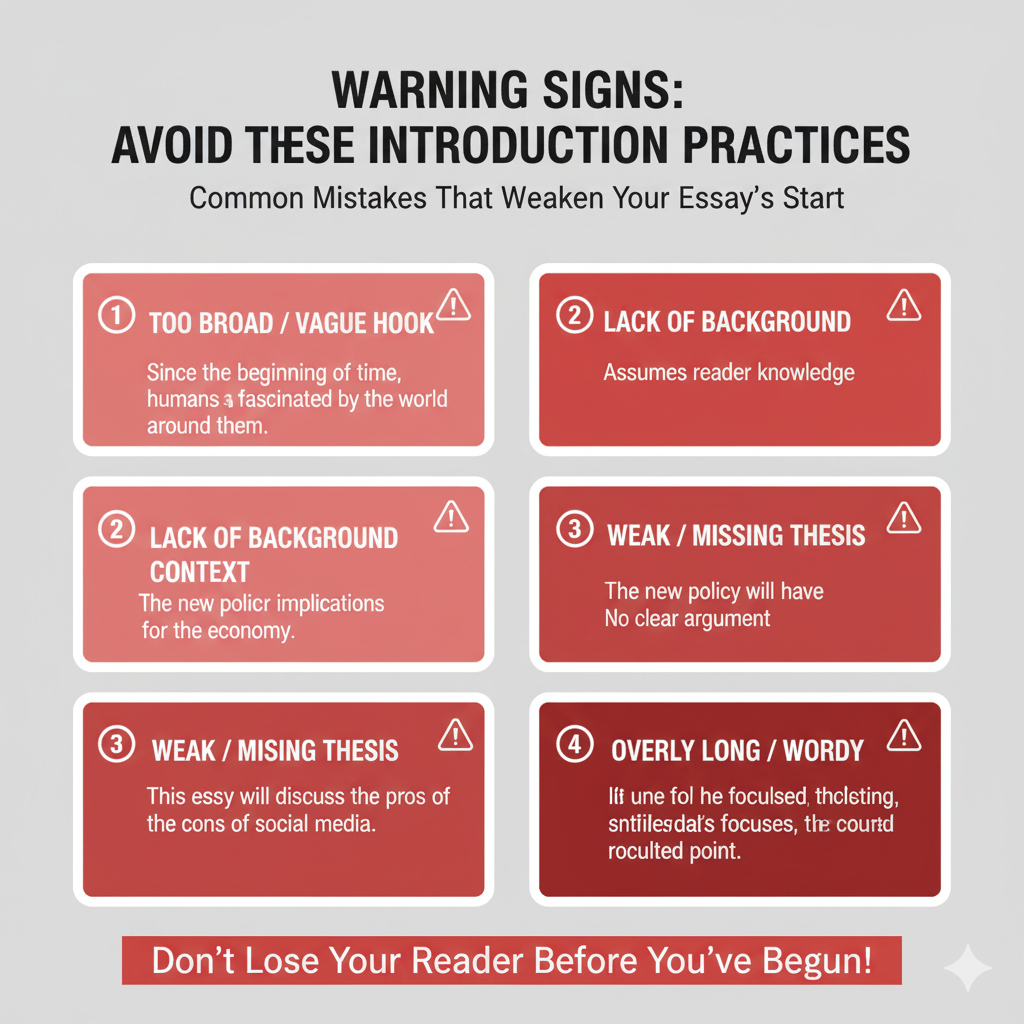
Even experienced writers make these common introduction errors:
- Dictionary definitions: Starting with “According to Merriam-Webster…” is overused and unoriginal.
- Overly broad statements: “Since the beginning of time…” is too general to be meaningful.
- Announcing your intentions: Avoid “In this essay, I will discuss…” which feels mechanical.
- Irrelevant information: Stay focused on details that directly relate to your thesis.
- Too much detail: Save specific evidence for your body paragraphs.
- Weak thesis statements: Ensure your thesis is specific and arguable.
Avoiding these pitfalls will immediately strengthen your introduction.
Key Takeaways
Writing an effective essay introduction doesn’t have to be complicated. Remember these key points:
- Hook readers with something interesting and relevant
- Provide just enough background for context
- Present a clear, specific thesis statement
- Keep it concise and focused
- Revise after writing your full essay
With practice, you’ll find that strong introductions become second nature, setting up both you and your readers for a successful essay experience.
The time you invest in crafting a strong introduction pays off throughout your entire paper, creating a positive first impression and a clear roadmap for what follows.
What introduction techniques have worked best for your essays? Try implementing these strategies in your next paper and watch your writing become more engaging from the very first sentence.