Struggling with your literature review? You’re not alone. Many students find this critical academic task challenging. In this guide, I’ll walk you through exactly what a literature review is, why it matters, and how to write one that impresses your professors.

What is a Literature Review?
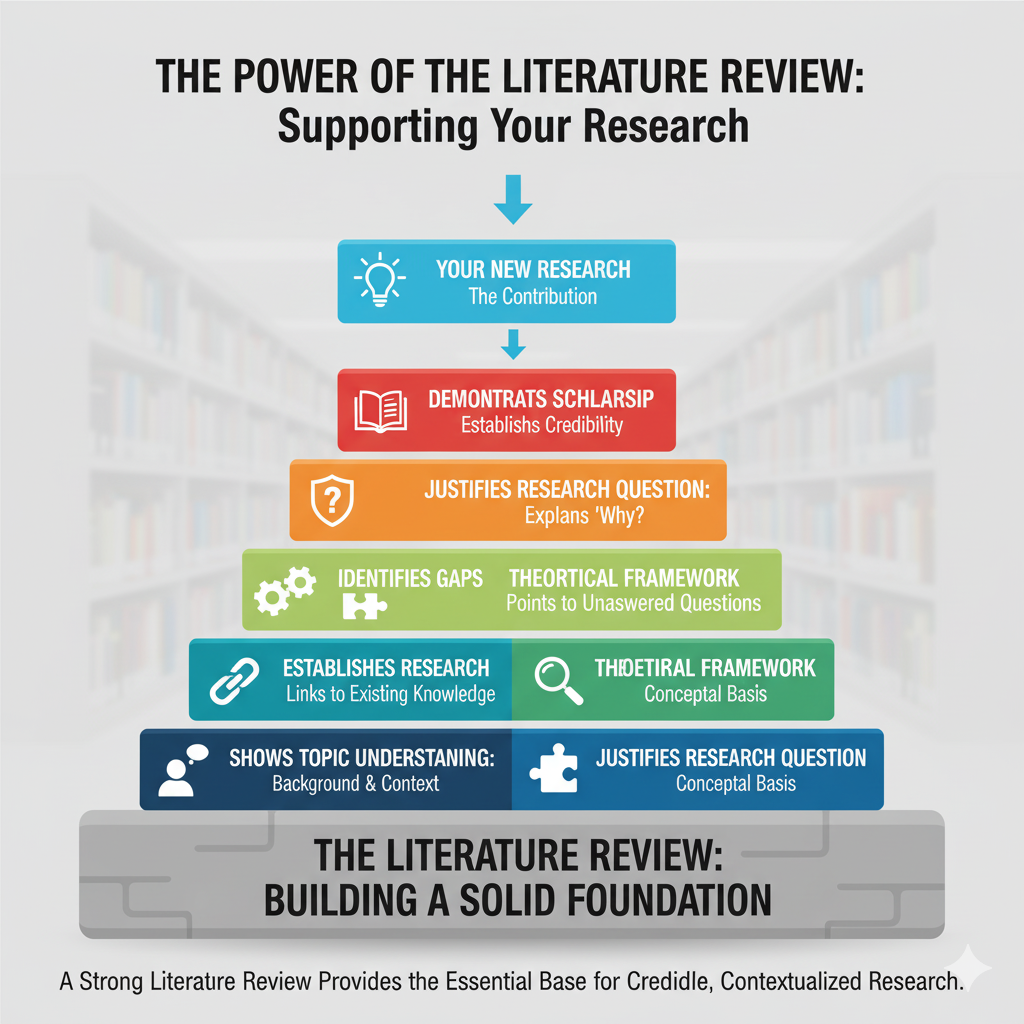
A literature review is more than just a summary of sources. It’s a critical analysis of existing research on your topic. Think of it as creating a conversation among researchers who’ve studied your subject before.
When you write a literature review, you’re showing your reader what’s already known about your topic. You’re also pointing out gaps, controversies, and trends in the research.
Unlike an annotated bibliography that simply lists sources, a literature review connects ideas and identifies patterns across multiple works.
Purpose of a Literature Review
Why spend time reviewing what others have written? Because good research builds on what came before it. Your literature review serves several important purposes:
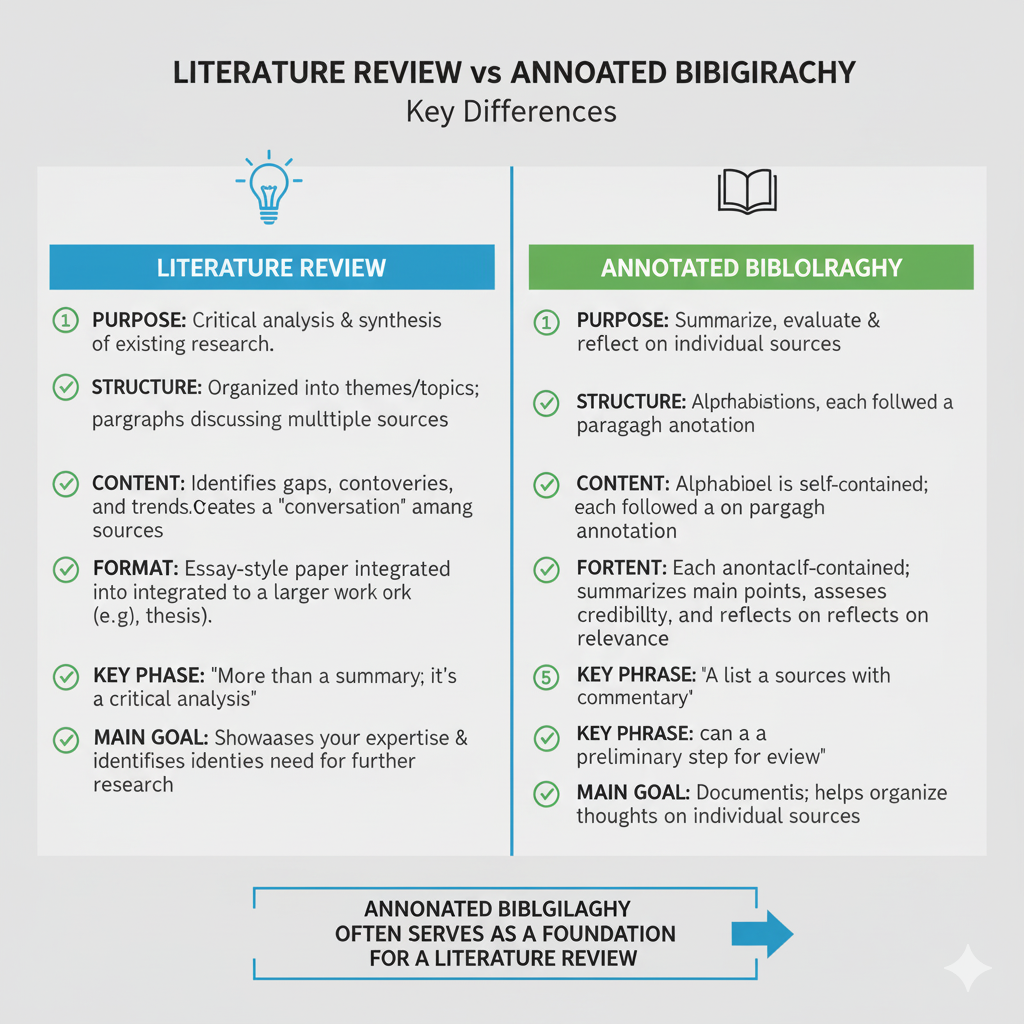
- Shows your understanding of the topic’s background
- Establishes your research within the existing knowledge
- Identifies gaps your work will address
- Helps develop your theoretical framework
- Justifies your research question
- Demonstrates your scholarly abilities to your professor
Think of your literature review as building the foundation for your own research. Without this solid base, your work lacks context and credibility.
Types of Literature Reviews
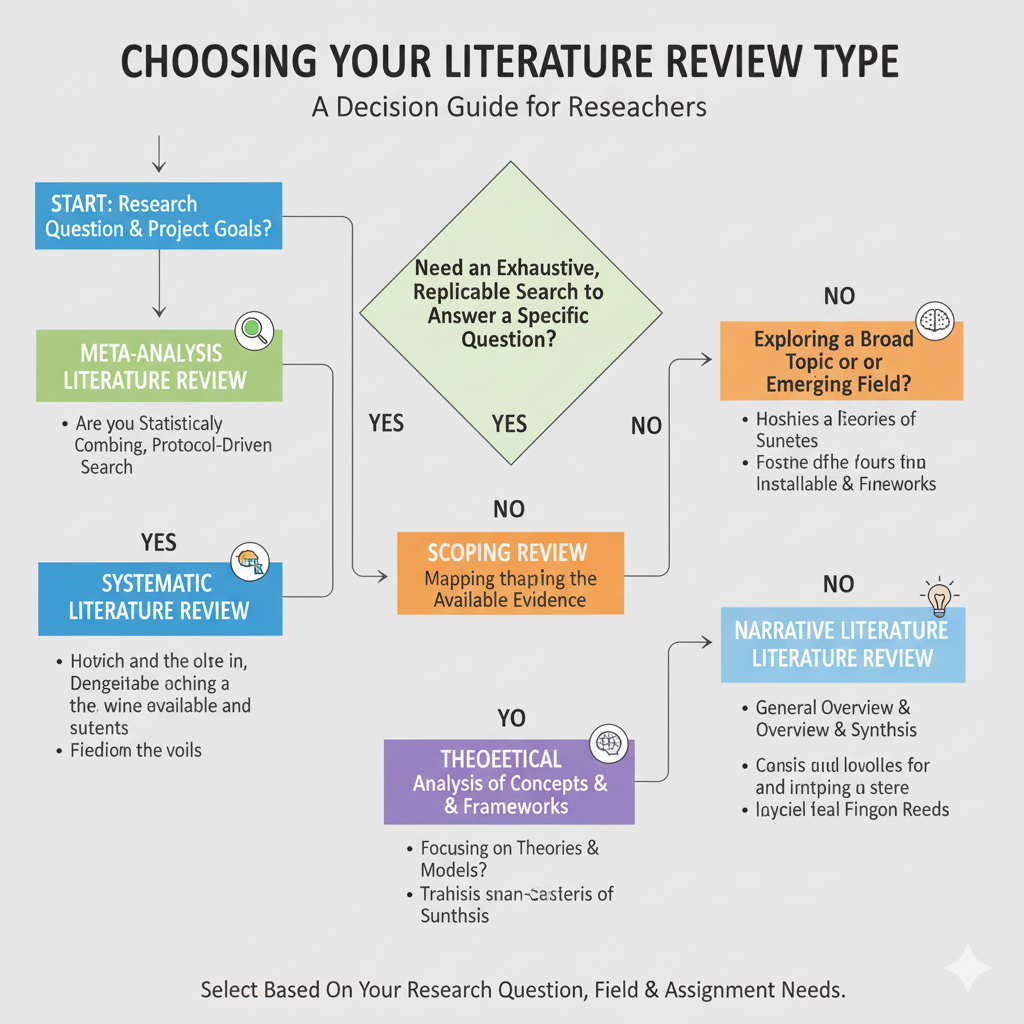
Different research projects require different approaches to literature reviews. Here are the main types you might need to write:
Narrative Literature Review
The most common type that provides a broad overview of existing research. It summarizes and synthesizes but may not follow strict systematic methods.
Systematic Literature Review
Follows rigorous, predefined methods to identify and analyze all relevant studies. Common in healthcare and policy research.
Meta-Analysis
A statistical approach that combines results from multiple studies to identify patterns and draw stronger conclusions.
Scoping Review
Maps the available evidence without deeply assessing quality. Useful for examining emerging topics.
Theoretical Review
Focuses on theories related to your topic rather than empirical research.
The type you choose depends on your research question, field, and assignment requirements.
Three Types of Literature Review Organization
Organizing your literature review effectively is crucial. Here are three common approaches:
| Organization Type | Explanation | Usage |
|---|---|---|
| Chronological | Organized by publication date or history of topic | Use when sequential development of ideas is important |
| Thematic | Organized by topic or issue, may include chronology or importance ranking | Use to move from general themes to specific topics (e.g., education → higher education → writing centers) |
| Methodological | Organized by the research methods used, not content | Use when comparing different research approaches is central to your analysis |
Choose the organization that best helps you tell the story of research in your field.
How to Write a Literature Review: Step-by-Step
Step 1: Define Your Research Question
Start with a clear focus. What exactly are you trying to learn? Your research question guides which sources you’ll include and how you’ll analyze them.
For example, if you’re researching “social media effects on teenagers,” that’s too broad. Narrow it to “how Instagram use affects teenage girls’ body image in the United States.”
A focused question makes your literature review manageable and meaningful.
Step 2: Search for Relevant Literature
Now it’s time to find your sources. Here’s how to search effectively:
- Create a list of keywords related to your topic
- Use academic databases (Google Scholar, JSTOR, etc.)
- Check reference lists of relevant articles
- Include both classic and current sources
- Look for peer-reviewed journal articles, books, and conference papers
Keep track of your search terms and where you found each source. This saves time if you need to find something again later.
Pro tip: Set up alerts in research databases to receive notifications about new publications on your topic.
Step 3: Evaluate and Select Sources
Not all sources deserve a place in your literature review. Evaluate each one by asking:
- Is it relevant to my research question?
- Is it from a credible source?
- How recent is it? (Some fields require very current sources)
- How often has it been cited by others?
- What are its strengths and limitations?
Create a system for taking notes on each source. Include the citation, key points, methodology, findings, and your own thoughts.
Remember to record complete citation information from the start—you’ll thank yourself later!
Step 4: Identify Themes, Debates, and Gaps
As you read, look for patterns across your sources:
- What themes keep appearing?
- Where do researchers disagree?
- What questions remain unanswered?
- How has thinking on this topic evolved?
- What methodologies are most common?
Create a concept map or matrix to help visualize connections between sources. This helps you see the big picture beyond individual studies.
Step 5: Outline Your Literature Review
Before writing, plan your structure. Will you organize by:
- Themes or concepts?
- Chronology (historical development)?
- Methodology?
- Theoretical approach?
Most literature reviews use a thematic organization, grouping sources by shared ideas rather than reviewing each source separately.
Create a detailed outline with your main sections and the sources you’ll discuss in each. This roadmap makes writing much easier.
Step 6: Write Your Literature Review
Now you’re ready to write! A well-structured literature review typically includes:
Introduction
- Define your topic and establish its importance
- Explain your review’s purpose and organization
- Present your research question or thesis statement
Body
- Organize by themes, approaches, or chronology
- Synthesize sources rather than summarizing each individually
- Compare and contrast different viewpoints
- Highlight agreements and contradictions in the literature
- Evaluate the strengths and weaknesses of studies
Conclusion
- Summarize the major findings in the literature
- Identify gaps or unanswered questions
- Explain how your research will contribute to the field
- Connect back to your research question
Remember to focus on analysis rather than just description. Don’t just tell what each source says—explain what it means for your field.
Examples of Summary, Synthesis, and Evaluation
Understanding the difference between summary, synthesis, and evaluation is crucial for writing an effective literature review. Here are examples on communication styles between married couples:
Summary Example
“In Frisby and Booth-Butterfield’s study, they provide research on how flirting with one’s spouse creates positive benefits within the relationship.”
This simply states what one study found without connecting it to other research.
Synthesis Example
“In Frisby and Booth-Butterfield’s (2012) research on the purpose of flirtation, they found that the biggest reason for flirtation within marriage was to create a more intimate world between the couple and to encourage sex. They also found that women were more likely to utilize flirtation. However, in a separate study on flirtation, men were also found to use attentive flirting as a way to make their wives feel attractive (Frisby, 2009). Agreeing with previous research, Frisby found that men usually flirt to engage in sex, and women flirt to encourage attention, fun, and interest in their spouses.”
This connects multiple studies, showing patterns and relationships between findings.
Evaluation Example
“Overall, Horan and Booth-Butterfield’s study demonstrates the significant effects of negative communication on the perceptions of perspective-taking between spouses. However, their small sample size (n=42) limits generalizability, and their focus on newly married couples may not reflect dynamics in long-term marriages.”
This assesses the quality and limitations of the research.
Your literature review should include all three elements, with synthesis and evaluation being particularly important.
![Image suggestion: Comparison table showing characteristics of summary vs. synthesis vs. evaluation with color coding]
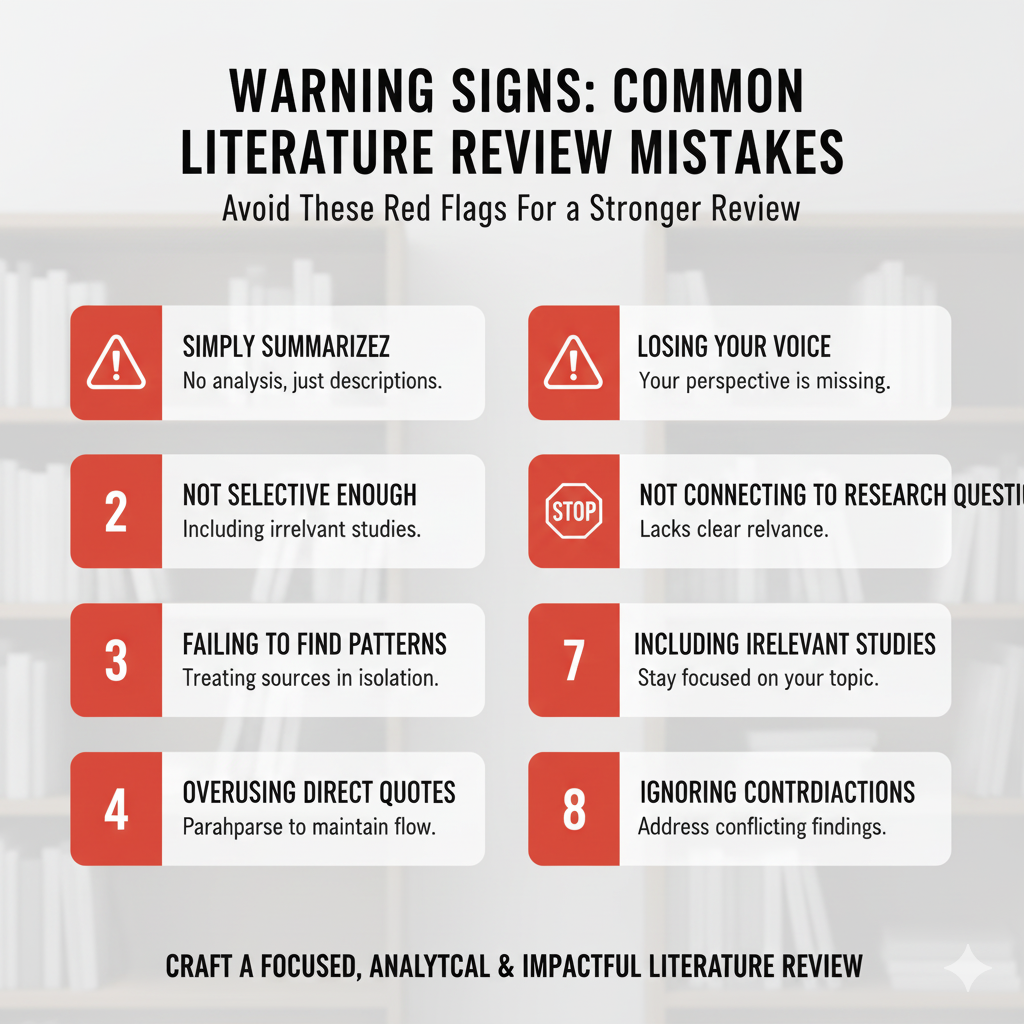
Common Literature Review Mistakes to Avoid
Even experienced researchers make these mistakes. Watch out for:
- Simply summarizing sources instead of analyzing them
- Not being selective enough about which sources to include
- Failing to find patterns across different studies
- Overusing direct quotes instead of paraphrasing
- Losing your own voice among all the cited works
- Not connecting the review to your research question
- Including irrelevant studies just because they’re on your topic
- Not addressing contradictions in the literature
Remember, your literature review should tell a coherent story about your research area, not just list what others have done.
Tips for Writing an Effective Literature Review
These practical strategies will help make your literature review stand out:
- Start early – Literature reviews take time to develop properly
- Use citation management software like Zotero or Mendeley
- Create a synthesis matrix to track themes across sources
- Write as you go rather than reading everything first
- Seek feedback from peers or advisors on early drafts
- Use clear transitions between sections and ideas
- Revise for coherence after completing your draft
- Check that every paragraph connects to your main argument
- Update your review if new relevant research emerges
Think of your literature review as a conversation you’re joining, not a list of books you’ve read.
Literature Review Examples by Field
Different academic fields have slightly different expectations for literature reviews. Here are brief examples:
Psychology Literature Review Example
“Research on mindfulness meditation has expanded dramatically in the past decade. Early studies focused primarily on stress reduction (Kabat-Zinn, 1990), while more recent work examines its effects on attention regulation (Davidson & Kaszniak, 2015) and emotion processing (Chambers et al., 2009). However, methodological inconsistencies in defining and measuring mindfulness have led to conflicting results (Van Dam et al., 2018)…”
Engineering Literature Review Example
“Carbon fiber reinforced polymers (CFRPs) have been increasingly utilized in aerospace applications since the 1970s. Initial research by Smith and Jones (1975) established baseline tensile properties, while subsequent studies focused on improving impact resistance (Zhang, 2005) and environmental durability (Miller et al., 2018). Recent innovations in manufacturing techniques, particularly automated fiber placement (AFP), have addressed earlier scalability challenges (Johnson, 2020)…”
Education Literature Review Example
“Research on flipped classroom models has evolved from early case studies (Bergmann & Sams, 2012) to more rigorous comparative analyses. Several studies have demonstrated improved student engagement (Johnson, 2016; Williams, 2018), while others found minimal impact on standardized test scores (Chen et al., 2017). A key debate centers on whether benefits vary by subject area, with stronger evidence supporting effectiveness in STEM disciplines (Garcia, 2019) than in humanities (Thompson, 2020)…”
Study examples in your specific field to understand the conventions and expectations.
How to Check and Revise Your Literature Review
Before submitting your literature review, use this checklist:
- Does your introduction clearly state the topic and purpose?
- Have you identified themes, trends, and gaps in the literature?
- Is your organization logical and easy to follow?
- Have you synthesized sources rather than just summarizing them?
- Did you evaluate the strengths and limitations of studies?
- Are your transitions between sections smooth and logical?
- Does your conclusion connect back to your research question?
- Have you properly cited all sources?
- Is your writing clear, concise, and academic in tone?
- Have you proofread for grammar and spelling errors?
Consider asking a peer or mentor to review your work using this checklist.
Key Takeaways
Writing an effective literature review takes time and careful analysis, but these key points will help you succeed:
- A literature review is a critical analysis of existing research, not just a summary
- Organize your review by themes, chronology, or methodology based on what best suits your topic
- Focus on synthesizing sources and identifying patterns, not just describing individual studies
- Evaluate the strengths and limitations of the research you review
- Connect everything back to your research question or purpose
- Revise carefully to ensure your literature review tells a coherent story about your field
With practice, you’ll become skilled at joining the scholarly conversation in your field through well-crafted literature reviews.
Remember, a strong literature review doesn’t just show what you’ve read—it demonstrates how well you understand your field and where your own research fits into the bigger picture.